Awards
Every year, NOF invites young researchers to enter the Nordic Hatton Award Competition
The Scandinavian Association for Dental Research (Scandinavian Division of IADR, also known as Nordisk Odontologisk Förening, NOF) awards two NOF Hatton Awards to qualified young researchers to compete in the world-wide IADR Hatton Competition. Awardees are selected on the basis of a competition (oral presentation) at the annual NOF scientific meeting.
Requirements
The competition is open for:
1) undergraduate students
2) post-graduate students under Masters, PhD, or speciality training
3) post-doctoral researchers (within 3 years of their PhD defence date at the time of grant application)
Entrants must be a citizen of Denmark, Estonia, Finland, Iceland, Latvia, Lithuania, Norway or Sweden – or persons of other nationalities whose research was conducted in one of these countries.
The candidate MUST be a member of NOF.
The research may not have been published (even as an abstract) or presented at any national or international meeting (excluding state, regional, or institutional meetings) prior to competition.
Persons who have previously won the competition, may not participate again.
Application
Submission of an abstract for the NOF Annual Meeting is made via the normal online process by the abstract submission deadline date.
During the submission, select NOF Hatton award.
For more information, please contact NOF’s secretary general, Dr. Ulvi Gürsoy (ulvi.gursoy@utu.fi).
Judging Criteria
The NOF Review Committee (three persons) will evaluate the work/performance as follows: 40% for verbal presentation (not more than 10 minutes), 30% for question-and-answer period (not to exceed 5 minutes), and 30% for scientific merit.
The following will be considered:
– originality and design of the investigation
– quality of the data produced
– suitability of the methods of analysis used
– scientific value of the work
– quality of the oral presentation
– demonstrated mastery of the subject
Awards
All entrants will receive a certificate confirming participation.
NOF will select the two most outstanding presentations. These two will receive a monetary award (1000 euro each) and a certificate. The winners will have the opportunity to compete (with winners from other Divisions and sections) in the world-wide IADR/Unilever Hatton Competition at the next IADR international conference. Expenses in connection with attendance of the winners at the international conference (airfare, hotel and meeting registration) will be covered.
Winners of the NOF Hatton Award
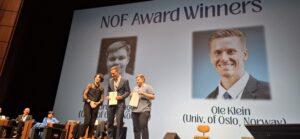
2026: Andreas Sagen (University of Oslo, Norway) and Ole Klein (University of Oslo, Norway)
Previous winners:
2025: Merve Üçtaşlı (University of Turku, Finland) and Kazi Shefaul Mulk Shawrob (University of Oslo, Norway)
2024: Åshild Johansen (University of Bergen, Norway) and Ingrid Beate Ringstad (University of Oslo, Norway)
2023:Anna Inari Mäkinen (University of Helsinki, Finland) and Samira Elmanfi (University of Turku, Finland)
2022: Shuntaro Yamada (University of Bergen, Norway) and Sini Riivari (University of Turku, Finland)
2021: Navdeep Kaur Brar (University of Oslo, Norway) and Mirjam Majster (Karolinska Institute)
2020: Sarah Kamounah (University of Copenhagen) and Håvard Hynne (University of Oslo, Norway)
2019: Van Thai Nguyen (University of Tartu, Estonia) and Faleh Abushahba (University of Turku, Finland)
2018: Kjersti Sturød (University of Oslo, Norway) and Samih Mohamed Ahmed (University of Bergen, Norway)
2017: Siddharth Shanbhag (University of Bergen, Norway) and Victor Tollemar (Karolinska Institute, Sweden)
2016: Eero Karjalainen (University of Turku, Finland) and Sanja Petronijevic (University of Oslo, Norway)
2015: Dareen Fteita (University of Turku, Finland) and Gabriela Salvadori da Silva (University of Oslo, Norway)
2014: Roger Junges (University of Oslo, Norway) and Haleh Davanian Mohaghegh (Karolinska Institute, Sweden)
2013: Roda Seseogullari-Dirihan (University of Turku, Finland) and Torbjørn Østvik Pedersen (University of Bergen, Norway)
2012: Jaana Helenius Hietala (University of Helsinki) and Ellen Kaas (university of Copenhagen, Denmark)
2011: Mervi Gürsoy (University of Turku, Finland) and Tove Båge (Karolinska Institute, Sweden)
